If you’ve started touring nurseries in Dubai, you’ve probably heard the term “EYFS” thrown around a lot. Admissions staff mention it, prospectus booklets are full of it, and yet very few people actually stop to explain what it means or why it matters for your child. As a parent, you don’t need to become an education expert — but understanding the basics of the EYFS curriculum will help you ask better questions on nursery tours and feel more confident about the choice you’re making.
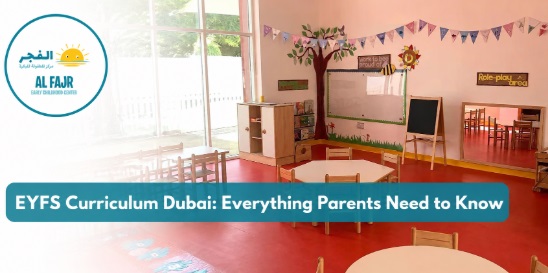
EYFS Curriculum Dubai – Al Fajr Early Childhood Center classroom
A play-based EYFS learning environment at Al Fajr Early Childhood Center, Dubai
What Does EYFS Actually Stand For?
EYFS stands for the Early Years Foundation Stage. It’s a curriculum framework developed in the UK for children from birth to age five, and it’s now widely used across Dubai’s British-curriculum nurseries. Rather than focusing on rote memorisation or formal desk-based learning, EYFS is built around the idea that young children learn best through play, exploration, and real-world experiences.
Nurseries following EYFS in Dubai are typically inspected or benchmarked against the same standards used in the UK, which is one reason many parents specifically look for “EYFS nursery Dubai” when shortlisting options — it’s a recognisable quality marker, especially for families who may relocate internationally down the line.
The Seven Areas of Learning
At the heart of EYFS are seven areas of learning, split into two groups.
The three prime areas are considered the foundation for everything else:
- Communication and Language – listening, understanding, and expressing ideas
- Physical Development – fine and gross motor skills, coordination, and healthy habits
- Personal, Social and Emotional Development – confidence, self-regulation, and building relationships
Once a child has a solid grounding in these, four specific areas build on top:
- Literacy – early reading and mark-making
- Mathematics – numbers, shapes, patterns, and measurement
- Understanding the World – nature, technology, community, and culture
- Expressive Arts and Design – imagination through art, music, and role play
A well-run EYFS classroom will weave all seven areas into everyday play — a sandpit activity might quietly be building physical development, maths (counting scoops), and language (describing textures) all at once.
How EYFS Differs From Other Curriculums in Dubai
Dubai is home to a wide mix of curricula — American, IB, Indian, and British among them — and this is often where parents get stuck comparing options. The biggest difference between EYFS and, say, an American pre-K programme is the degree of structure. American curriculums tend to introduce more formal, teacher-led instruction earlier, with defined learning objectives per subject. EYFS, by contrast, leans heavily on child-initiated play, with teachers observing and gently guiding rather than directing.
Neither approach is objectively “better” — it depends on your child’s temperament and your own priorities. Some children thrive with the free-flowing, exploratory nature of EYFS; others do well with more structured routines. If you’re still weighing this up, it’s worth reading how EYFS compares specifically to the American curriculum in more detail, since the two are the most commonly compared systems in Dubai nurseries.
What EYFS Looks Like Day to Day
Walk into a genuine EYFS setting and you’ll notice a few things immediately:
- Continuous provision – classrooms are set up in learning “stations” (sand, water, blocks, books, role play) that children can move between freely
- Observation-based assessment – instead of tests, teachers keep learning journals with photos and notes tracking each child’s progress against developmental milestones
- Outdoor learning – EYFS places strong emphasis on outdoor play as part of the curriculum, not just as a break from it
- Key person system – each child is assigned a key staff member responsible for their emotional wellbeing and development tracking
If a nursery claims to follow EYFS but you don’t see these elements during a tour, it’s worth asking direct questions about how the framework is actually implemented day to day, rather than just used as a marketing label.
Questions to Ask During Your Nursery Tour
Since EYFS can be interpreted differently from one nursery to another, here are a few pointed questions worth asking:
- Is the nursery registered or benchmarked against UK EYFS standards, and by whom?
- How is my child’s progress tracked and shared with parents?
- What does a typical day look like across the seven areas of learning?
- How much outdoor time is built into the daily schedule?
- What is the staff-to-child ratio, especially for the youngest age groups?
A confident, detailed answer to these questions is usually a good sign that EYFS is being delivered properly, not just listed on a brochure.
Is EYFS Right for Your Child?
For most families settling in Dubai — especially those who may move again internationally, or who eventually plan to enrol in a British curriculum school — EYFS offers a smooth, globally recognised starting point. It builds independence, curiosity, and social skills before formal academics take over in Year 1, which many educators believe leads to more confident, adaptable learners later on.
That said, the “right” curriculum ultimately depends on your child’s personality, your family’s long-term schooling plans, and what feels right when you walk through the classroom door. No framework replaces the value of visiting in person, watching a session in progress, and asking the staff hard questions.
If you’re still in the early stages of your search, take time to visit a few nurseries, compare how each one interprets EYFS in practice, and trust what you observe over what’s printed in a prospectus.
Frequently Asked Questions
At what age does EYFS start in Dubai nurseries?
Most Dubai nurseries begin EYFS provision very early — often from 45 days to 3 months old — and continue through to around age 4, when children typically move on to KG1 or Reception.
Is EYFS regulated in Dubai?
Yes. KHDA (Knowledge and Human Development Authority) oversees nursery quality in Dubai and publishes inspection reports rating each nursery across several domains. It’s worth checking a nursery’s latest KHDA rating before enrolling, since it’s a fairly reliable signal of how consistently the curriculum is actually delivered, not just advertised.
What’s the difference between EYFS and Montessori?
They’re not really competing systems — EYFS defines what children should learn (the seven areas and early learning goals), while Montessori is more about how that learning happens, through specific materials and child-led work. Quite a few Dubai nurseries actually run a Montessori-style classroom while still tracking children’s progress against EYFS goals.
Does EYFS prepare children for both British and American schools later on?
Generally, yes. Because EYFS focuses on foundational skills — communication, independence, early literacy and numeracy — rather than a specific national syllabus, most children transition smoothly into either a British or American curriculum primary school afterward.
How is my child assessed under EYFS if there are no formal tests?
Teachers use ongoing observation instead of exams — noting what a child is curious about, tracking milestones, and sharing progress through learning journals, photos, and regular parent updates rather than graded report cards.
Can I switch nurseries mid-year without disrupting my child’s EYFS progress?
Usually yes, since EYFS is a standardised framework. A good receiving nursery will ask for your child’s existing learning journal or progress notes to pick up right where the previous one left off.