If you’ve started looking into nurseries in Dubai, chances are you’ve come across the term “EYFS” more times than you can count. And if you’re not from the UK, it probably left you with more questions than answers. What exactly is it? Is it better than other early years programs? And does it actually matter for your child’s future?
Here’s a straightforward guide to help you make sense of it — and figure out what to actually look for when choosing an EYFS nursery in Dubai.
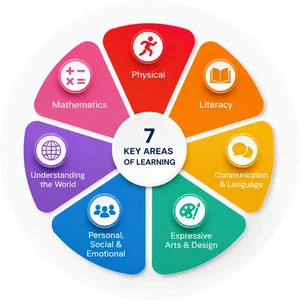
7 Key Areas of EYFS Learning and Development
The EYFS framework covers seven key areas of development — Physical, Literacy, Communication & Language, Expressive Arts & Design, Personal Social & Emotional, Understanding the World, and Mathematics — forming the foundation of early years education in Dubai nurseries.
What Is EYFS Really?
EYFS stands for the Early Years Foundation Stage — a curriculum framework developed in the UK for children from birth to age 5. It’s not just a set of subjects; it’s a structured approach to how young children learn, grow, and develop during the most formative years of their lives.
The framework is built around seven areas of development:
- Communication and language
- Physical development
- Personal, social and emotional development
- Literacy
- Mathematics
- Understanding the world
- Expressive arts and design
The first three are considered “prime” areas — the foundation everything else builds on — while the remaining four are “specific” areas that grow out of them. Together, they’re designed to develop a well-rounded child, not just one who can recite the alphabet early.
Why EYFS Leans on Play — And Why That’s a Good Thing
A lot of parents raised on traditional, textbook-heavy education find it hard to trust play-based learning at first. It can look, from the outside, like children are “just playing.” But that’s exactly the point — and the research backs it up.
Young children absorb language, problem-solving, and social skills far more effectively through hands-on exploration than through rote instruction. A child stacking blocks is quietly learning balance, spatial reasoning, and cause and effect. A child negotiating turns on a slide is learning empathy, patience, and communication — skills no worksheet can teach at that age.
EYFS structures this play so it isn’t random. Every activity is designed with a developmental goal in mind, and trained practitioners observe, guide, and gently extend a child’s learning without turning it into forced instruction. The result is children who genuinely enjoy learning — which, in the long run, matters more than how early they learned to sit still at a desk.
How This Plays Out in Real Nurseries
In a well-run EYFS nursery, you’ll notice the difference the moment you walk in. Classrooms are set up in learning “areas” rather than rows of desks — a reading corner, a sensory table, a construction zone, a role-play kitchen. Children move between these areas guided by curiosity, with teachers stepping in at the right moments to ask questions, introduce new vocabulary, or nudge a child toward the next stage of a skill.
Assessment looks different too. Instead of tests, good EYFS nurseries track development through ongoing observation — noting what a child is curious about, where they’re excelling, and where they might need more support. Parents typically get regular updates through learning journals, photos, and progress reports rather than report cards filled with grades.
The best nurseries also build strong routines around independence — encouraging children to pour their own water, put on their own shoes, or resolve small conflicts with a friend. These small moments matter far more than they seem to, because they build the confidence and self-regulation children need before they even start formal schooling.
Frequently Asked Questions
1. Is EYFS recognized internationally?
Yes. EYFS is the statutory framework for early years education in England, but it’s also widely adopted by British curriculum schools and nurseries around the world, including in the UAE. Its focus on holistic development is respected globally, and children who complete it transition smoothly into international primary curricula, including the UK National Curriculum and IB Primary Years Programme.
2. What age does EYFS start?
EYFS covers children from birth to age 5, ending in the Reception year (the year before Year 1 begins). In Dubai, most nurseries start EYFS provision from as early as 3 months up through age 4, before children move on to KG1 or Reception.
3. EYFS vs Montessori — what’s the difference?
Both are play-based and child-centred, but they differ in structure. Montessori uses specific, self-correcting materials and allows children to choose activities largely independently, with less direct teacher-led input. EYFS is more flexible in its materials but places greater emphasis on structured observation, planned learning goals across all seven areas, and a blend of child-led and adult-guided activities. Neither is objectively “better” — it comes down to which structure suits your child’s temperament.
4. What should a child know before starting nursery?
Nothing academic, really. Nurseries don’t expect children to know letters or numbers beforehand. What helps most is basic independence — being comfortable separating from a parent for short periods, some familiarity with a daily routine, and exposure to simple social settings like playdates.
5. What do parents look for in a nursery?
Beyond curriculum, most parents prioritize safety and hygiene standards, staff-to-child ratios, qualified and experienced teachers, cleanliness, location and commute time, and a warm, communicative relationship between staff and parents. A trial visit or settling-in session tells you more than any brochure.
6. What is the age limit for KG1 in the UAE?
Children typically need to be at least 4 years old by a specified cut-off date (usually the beginning of the academic year) to join KG1 in the UAE, though exact age requirements can vary slightly between schools and curricula, so it’s worth confirming directly with your chosen nursery or school.
Making the Decision
Choosing a nursery is rarely just about curriculum on paper — it’s about finding an environment where your child feels safe, curious, and genuinely happy to show up each day. EYFS gives that environment a strong, research-backed structure to grow within.
If you’re weighing your options, it also helps to understand the practical side of things — what a nursery’s program actually includes, what the admissions process looks like, and what fees to budget for, which walk through everything step by step.