If you’re a parent starting the nursery search in Dubai, you’ve probably run into this question fairly quickly: EYFS or American curriculum? It sounds like a small administrative detail at first, but it actually shapes how your child spends their day, how they’re assessed, and — for many families — which school system they’ll stay on for the next decade or more.
Here’s a straightforward look at what each one actually means, so you can make the call with confidence rather than guesswork.
EYFS vs American Curriculum Nursery Dubai – Al Fajr Early Childhood Center
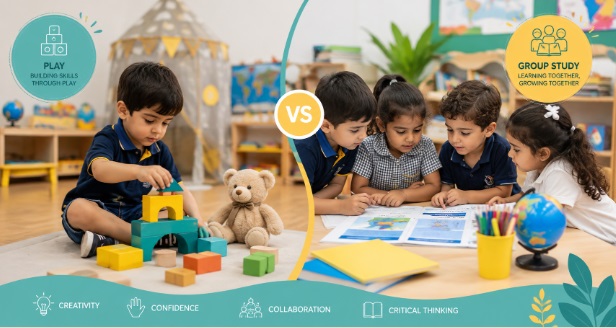
Comparing EYFS and American curriculum approaches for early childhood education in Dubai nurseries
What EYFS Actually Is
EYFS stands for Early Years Foundation Stage, and it’s the framework used by British curriculum nurseries and schools for children aged birth to five. In Dubai, it’s by far the most common choice — the British curriculum is followed by more private school students than any other system in the emirate.
The EYFS structure covers two stages before formal schooling begins: FS1 (roughly ages three to four) and FS2 (ages four to five), after which children move into Year 1 and formal primary education begins. Learning is organised around seven areas — things like communication and language, physical development, and early mathematics — but the delivery is heavily play-based. Children aren’t sitting at desks doing worksheets; they’re building, role-playing, exploring sand and water trays, and picking up academic concepts through guided play rather than direct instruction.
What the American Curriculum Looks Like at This Age
Nurseries following the American system use different terminology for the same early years — what EYFS calls FS1 is usually labelled Pre-KG or Pre-K, and FS2 becomes KG1. The year after that is KG2, which roughly lines up with Year 1 in the British system.
Structurally, the American curriculum runs on a K-12 model built around the US Common Core Standards, and it tends to introduce a bit more structure earlier — some letter recognition, numeracy basics, and classroom routines woven in alongside play. It’s not dramatically different from EYFS in the toddler and pre-nursery years, but by KG1 and KG2 you’ll typically see a slightly more academic tone compared to the fully play-led EYFS approach at the same age.
The Real Differences That Matter for a Nursery-Age Child
At the nursery stage, the gap between the two systems is smaller than most parents expect. Both prioritise social development, motor skills, and early language over formal academics. That said, a few practical differences are worth knowing:
Pace and structure. EYFS leans further into unstructured, child-led play, especially in FS1. American-curriculum nurseries often introduce slightly more routine and early academic touchpoints a bit sooner.
Terminology and transitions. If you might relocate — to the UK, elsewhere in the Gulf, or back to the US — it’s worth thinking about which labels and progression your child will need to slot into later. Switching between systems is generally much easier at this age than it is once a child is several years into primary school.
Assessment style. EYFS uses ongoing observational assessment rather than tests — teachers track development against the seven learning areas continuously. American-curriculum settings may introduce more structured checkpoints slightly earlier, though nothing resembling formal exams at this stage.
Long-term pathway. This is really the bigger question hiding behind the nursery choice. British curriculum schools lead toward IGCSEs and A-Levels, with earlier subject specialisation from Year 10 onward. American curriculum schools lead toward a US high school diploma with a broader spread of subjects maintained all the way through graduation. Neither path is “better” — they simply suit different university plans and, frankly, different family circumstances.
So Which One Should You Choose?
Honestly, for a nursery-age child, the deciding factor usually isn’t the curriculum label itself — it’s what happens after nursery. A few questions worth sitting with:
- Do you see your family staying in Dubai through primary and secondary school, or is relocation likely in the next few years?
- If you do relocate, where to — and which system would your child need to join there?
- Does your child seem to thrive with more open-ended, exploratory play, or do they respond well to a bit more early structure?
If you’re still undecided, it’s worth remembering that switching curricula is far simpler at nursery age than later on. Many families choose the nursery that feels like the best day-to-day fit for their child and worry about the exact FS-versus-KG label a little less.
Frequently Asked Questions
Is EYFS or American curriculum better for a toddler?
Neither is objectively better — both focus on play, social skills, and early language at nursery age. The difference shows up more in pace and structure than in outcomes this early.
What age does EYFS start and end?
EYFS covers birth to age five, split into FS1 (around three to four years) and FS2 (around four to five years), after which children move into Year 1.
What’s the American curriculum equivalent of FS1 and FS2?
FS1 is usually called Pre-KG or Pre-K, and FS2 corresponds to KG1. The following year, KG2, is roughly equivalent to Year 1 in the British system.
Can I switch my child from EYFS to American curriculum later?
Yes, and it’s far easier to do at nursery or early primary age than later on, since the core skills being developed — language, motor skills, social development — transfer well between systems.
Which curriculum is more common in Dubai?
The British curriculum, including EYFS, is the most widely followed system in Dubai’s private education sector, though American curriculum schools are also well represented.
Does the nursery curriculum affect university options later?
Not directly at nursery age. The bigger pathway differences (IGCSEs and A-Levels versus a US high school diploma) only become relevant once your child enters formal schooling years later.